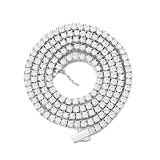
Explore current Diamond Tennis Necklace options and compare the design, materials, measurements and finish before you choose.
Read more
How to compare a diamond tennis necklace
A diamond tennis necklace is defined by a continuous line of closely set stones around the neckline. The detail that changes its character most is the stone pattern: a uniform row gives a clean, even line, while graduated stones put more emphasis at the centre. Compare the overall look with the length you would normally wear, because the same necklace can sit like a close collar, a classic short necklace or a layer beneath a pendant depending on its measurement.
Choose the stone setting
Prong settings allow more light around each stone and create a traditional sparkle-led finish. Bezel and channel settings look smoother because metal surrounds or holds the stones more closely. Alternating round and baguette patterns, oval cuts and square-cut rows all change the rhythm of the line. When viewing a diamond tennis necklace, look at the full pattern rather than one close-up image so you can judge whether its proportions remain balanced from clasp to clasp.
Check length, width and flexibility
Necklace length affects where the stone line rests and how easily it works with different necklines. Compare the stated centimetres or inches with a necklace you already own, then allow for the clasp at the back. Width matters too: a fine row can be an everyday choice, while a wider tennis necklace has a stronger evening or occasion look. Flexible links should lie smoothly when the necklace curves, without appearing stiff at the shoulders or around the front of the neck.
Look closely at the clasp and security
A tennis necklace needs a fastening that feels practical as well as neat. Read the listing for the main clasp type, any secondary safety catch and the instructions for opening it. A box clasp can create a discreet continuation of the stone line; a lobster clasp may be easier to handle. Check whether the necklace is described as suitable for regular wear, whether it needs special care, and how the maker recommends storing it to avoid tangling or catching the settings.
Metal colour and stone description
Silver-tone, yellow-gold-tone and rose-gold-tone finishes can make the same clear stones look very different. Match the finish with jewellery you already wear if you want a coordinated set, or select a contrasting tone for a more deliberate layered look. Confirm the exact base metal, plating, stone type and any care notes in the retailer description. Terms used in a title can be broad, so the specification and selected variation are the useful places to check.
Styling a tennis necklace
A fine tennis necklace can sit alone for a restrained look or form the brightest layer in a necklace stack. A bolder line is often easiest to wear as the main necklace, with other chains kept at clearly different lengths. For a gift, consider the recipient’s usual necklace length, metal preference and whether they prefer an even stone row or a central feature. A classic continuous design can work across daywear, events and formal occasions when the size and finish suit the wearer.
Before choosing a style
Compare several current listings side by side. Confirm the exact selected length, stone setting, fastening, material description, care guidance and return terms. Product photographs can make stones appear larger or brighter than their stated dimensions, so use the measurements and full specification to make the final comparison. That gives you a clearer basis for choosing a diamond tennis necklace that fits the intended look and wear pattern.
Think about everyday wear
For regular wear, consider how the necklace will be used rather than choosing only by sparkle. A short, fine tennis necklace may work neatly with open shirts, knitwear and simple necklines. A longer or wider design can make more sense for occasions when it will be the main piece of jewellery. If you plan to layer it, leave enough spacing between chains so the rows do not twist together. A design with a smooth underside and an easy clasp is usually more practical for repeated use.
Compare descriptions carefully
Listings for diamond tennis necklaces can describe cubic zirconia, crystal, laboratory-created stones, natural diamonds or other clear stones. These are not interchangeable terms. Read the material section for the precise description and do not rely on a general phrase in the product title. Also check whether the listed item is a necklace on its own or part of a jewellery set, and whether the stated measurement includes an extender. Small differences in wording can affect both the shape of the necklace and the accessories included.
Make a measured final choice
Use a tape measure or a piece of string to mark the listed length around your neck before ordering. This simple check helps show where the stone line will sit when standing, sitting and moving. If two designs look similar, compare their setting, width, metal tone, clasp and stated care requirements. A thoughtful comparison helps you choose a diamond tennis necklace for the actual occasion and wardrobe rather than selecting from a photograph alone.
Compare the stone line as a whole
With a diamond tennis necklace, the repeated line is as important as any individual stone. Review full-length photographs where they are available and compare whether the spacing appears even from the centre through to the clasp. A continuous row gives a clean, uniform effect; a design with a graduated centre or alternating shapes may direct attention more strongly to the front. Neither approach is automatically better, but the distinction helps you choose a design that suits the necklines and occasions you have in mind.
Questions to settle before ordering
Before selecting a design, confirm the stated length and width, the exact material and stone description, the clasp and any safety catch, the care guidance and the option currently selected. If the piece is intended as a gift, check the delivery and return information too. This short comparison keeps a diamond tennis necklace decision grounded in the details that affect how the necklace will sit and wear, rather than relying on the most dramatic image alone.